ARTICLE 1
THE DEVELOPMENT OF THEORY
OF ATOM
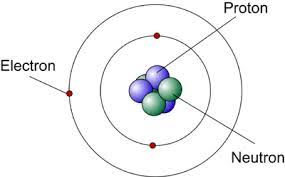
Atoms are a basic
unit of matter, composed of atomic nuclei and the negatively charged electron
clouds that surround it. The atomic nucleus consists of a positively charged
proton, and neutrons with neutral charge (except in the nucleus of Hydrogen-1
atom, which has no neutrons).
The term atom comes from Greek (ἄτομος / átomos, α-τεμνω), which means it can not be cut or something that can not be divided again. The concept of atom as an indivisible component was first proposed by Indian and Greek philosophers. In the seventeenth and eighteenth centuries, chemists laid the foundations of this idea by showing that certain substances could not be further divided using chemical methods. During the late nineteenth and early twentieth centuries, physicists managed to discover the structure and subatomic components within the atom, proving that 'atoms' are not indivisible. The principles of quantum mechanics used by physicists then succeeded in modeling atoms.
1. The Atomic Theory of Jonh Dalton

John
Dalton put forward the hypothesis of atoms under the law of conservation of
mass (Lavoisier) and the law of fixed comparison (Proust). Dalton's proposed
theory: Atom is the smallest part of matter that can not be divided again.
Atoms are described as very small solid spheres, an element having identical
and different atoms for different elements. The atoms combine to form compounds
with simple and integer ratios. For example water consists of hydrogen atoms
and oxygen atoms Chemical reactions are the separation or amalgamation of the
atoms, so that atoms can not be created or destroyed.

The atomic model of dalton The advantage of
Dalton's theory is to start an interest in research on the atomic model.
The disadvantage is not to explain the
relationship of oceans of compounds and electric current conductivity, if atoms
are the smallest part of a element and can not be subdivided.
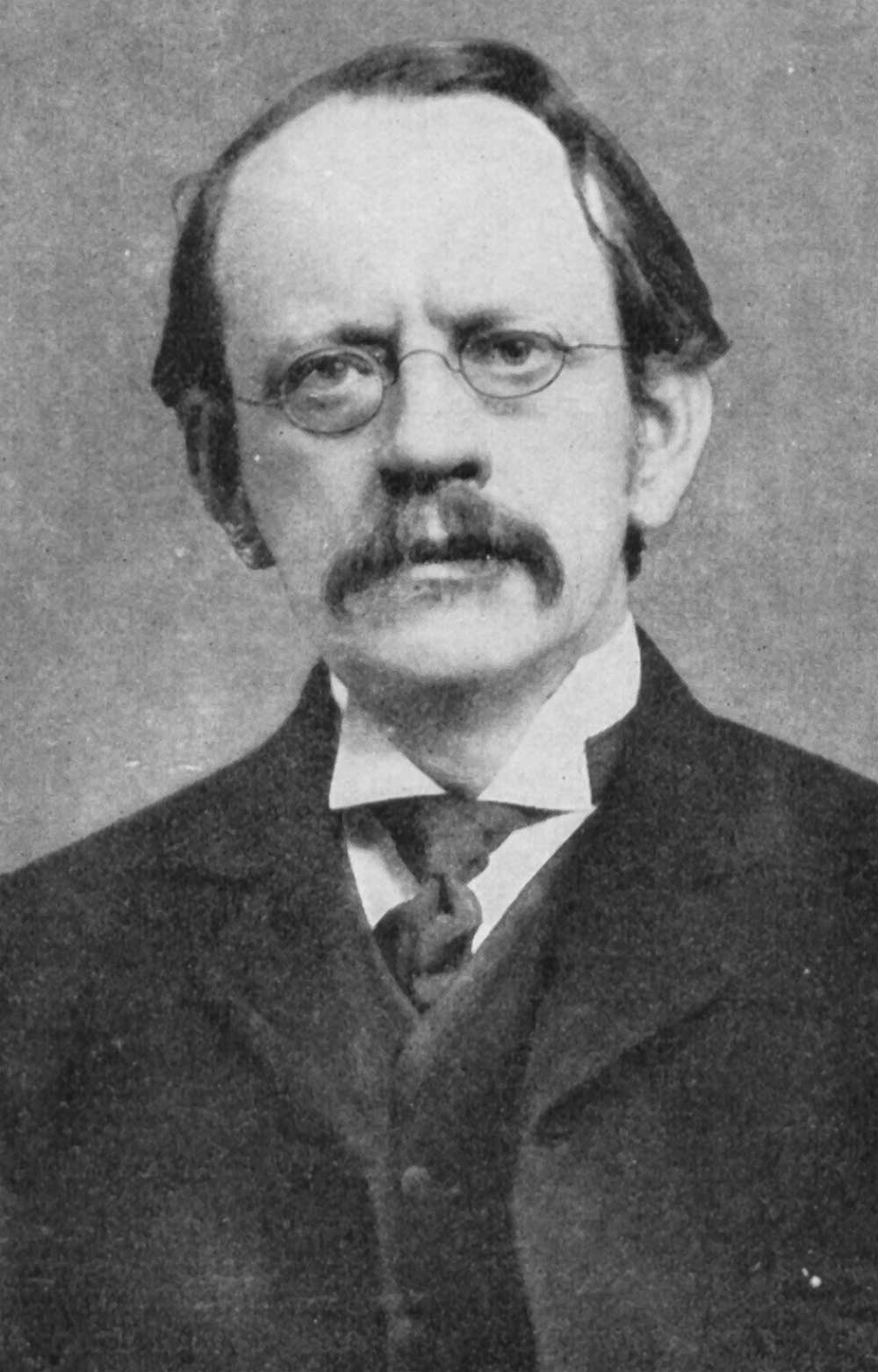
 The atom model proposed by Thompson is often referred to as a model of raisin bread with bread as positively charged atoms and raisins as the electrons are spread evenly across the bread section. Atom as a whole is neutral.

Some of the things described by Bohr area. Electrons orbit at certain energy levels called skin
2. Atomic Model Joseph John Thompson
3. Atomic Model Ernest Rutherford

4. Atoms Model Niels Bohr


5. Atomic Model of Wave Mechanics
The
development of the latest atomic model proposed by atomic model based on
quantum mechanics. This explanation is based on three theories namely The
theory of the duality of electron particle waves proposed by de Broglie in 1924
Uncertainty principle expressed by Heisenberg in 1927 The wave equation theory
by Erwin Schrodinger in 1926.
According
to this model of the atom, the electrons do not orbit on a particular path so
that the path proposed by Bohr is not a truth. This atomic model explains that
the electrons are in orbitals with a certain energy level. Orbital is the area
with the greatest possibility to find electrons around the atomic nucleus.


What the example of atomic in our body?
BalasHapusOxygen, carbon, hydrogen, nitrogen, phosphorus, potassium and some other atoms.
HapusBased on the image in your article, the electrons rotate on the track. What's all that and what if the electron is not on its track?
BalasHapusIf the electrons are released from their path or orbit they are called free electrons. Electrons that come out or apart from their orbit are usually due to outside influences. These detached electrons generate energy called energy or electric current. As a result of this friction arises heat or spark of fire like a piece of iron beaten with a hammer. Sparks are called free electrons. In the metal there are many free electrons, while in plastic and wood almost or even no electrons because the electrons of the object are almost tied to their atoms.
HapusMention the principles of quantum mechanics?
BalasHapus
Hapus1. Wave Functions: describe all objects in the universe within the wavefunction.
2. Allowance states: one of several limited conditions when electrons can be observed
3. Probability: the probability of finding electrons in limited conditions according to the wavefunction
Measurement: ensure the position and state of an object.
What is the difference between neutrons and electrons in the nucleus?
BalasHapus
HapusNeutrons or neutrons are subatomic particles that are neutral and have a mass of 940 MeV / c² (1.6749 × 10⁻²⁷ kg, slightly heavier than protons.) The rotation is ½.
The atomic nucleus of most atoms (all except the most common Hydrogen isotope, consisting of a proton) consists of protons and neutrons. Electrons are negatively charged particles. Electrons are located in atoms (bound to atomic nuclei) and cause chemical properties. In the metal, electrons are ebas (unbound atoms) so they can conduct an electric current.