Rabu, 26 April 2017

CONVERSATION BETWEEN TEACHERS AND STUDENTS ABOUT CHEMICAL LESSONS "OIL EARTH"


Hasil gambar untuk GURU MENGAJAR


Teacher : happy all day, how are you?
All students : noon Sir, and you?
Teacher : i am good and thank you. Ok, we will start studyng today. The material we will discuss is about petroleum. But, before you know what is oil?
Gita : Sir, I want to try explain what is oil.
Teacher : ok. Please
Gita : petroleum dubbed as black gold. Petroleum is a viscous liquid, black or greenish, flammable, and located in the upper layers of some of the earth's crusted places.
Atma : (raise my hand) I think petroleum is one form of hydrocarbon, a chemical compound containing hydrogen and carbon.
Teacher : nice Gita and Atma. Petroleum is a natural mixture of various hydrocarbon elements present in the liquid phase in the reservoir below the soil surface and remains liquid at atmospheric pressure above the surface, even though it has been through a surface separation facility.
Teacher : who knows the history of petroleum ?. Please explain.
Santa : The origin of Petroleum / Petroleum, natural gas, and coal are the 3 sources of fossil fuels derived from weathering the remains of living things. They are formed in a very long time and through a very long process that is about 300-350 million years. Among the three sources of fossil fuels, petroleum is the most widely used fuel in everyday life. Of the many sources of energy in the world 58.8% of which is petroleum
Teacher : nice Santa. Anyone want to add or argue other?
Mariana : Related to the origin of petroleum formation, there are at least 3 theories that reveal the secret behind how the material in Latin is called petrolium. The three theories are biogenetic theory, inorganic theory and duplex theory.
Teacher : can you explain Mariana the three theories?
Mariana : Yes sir.
1. The Origin of Petroleum Based on Biogenetic Theory (Organic Theory)
According to the Biogenitic Theory, petroleum is formed from the decay of various species of animals and plants (living creatures) that are dead and buried in mud deposits, washed away by river currents, into the sea, and finally gathered on the seafloor, met with stacks of weathering Living creatures that previously existed.
2. The Origin of Petroleum Based on Inorganic Theory
According to the Inorganic Theory, petroleum is formed by the activity of bacteria capable of performing biochemical reactions, altering elements such as Oxygen, Hydrogen, Carbon, Sulfur, and nitrogen from the parent rock to an oil substance containing hydrocarbons.
3. The Origin of Petroleum Based on Duplex Theory
Duplex theory is actually a blend of Biogenetic Theory and Inorganic Theory. This theory is widely accepted by scientists in general. In this theory, it is explained that petroleum comes from living materials both plant-based and vegetable in the sea, which due to the influence of temperature, pressure, and time finally turned into a parent rock forming hydrocarbon materials.
Teacher : nice Mariana. Do others understand the theories your friend told you about?
All students : understand sir.
Teacher : all right. We continue the discussion about the use of petroleum in everyday life. There are so many uses of petroleum that we use in our lives. For example,
Clothing
of hydrocarbon materials that can be used for clothing is PTA (purified terephthalic acid), which is made of para-xylene in which the material is essentially kerosene (kerosene). From this Kerosene all the ingredients are formed into aromatics, namely para-xylene.
Teacher : All right. Do any of you know what else the use of petroleum in everyday life?
Gita : I am sir. The following uses of petroleum, namely:
1. Board
Building materials derived from hydrocarbons are generally plastic. The plastic base material is almost the same as LPG, the polymer of propylene, the olefin / alkene compound of the carbon chain C3. Of plastic material is then finished assortment of products ranging from roofs (plastic tiles), furniture, home interior equipment, bumper cars, tables, chairs, dishes, etc.
2. art                                                                  
The main role of hydrocarbons is in oil inks and solvents. Perhaps the brothers and sisters know the thinner that is used to thin the paint. As for the affairs of sculpture many statues are made from plastic, etc ..
Hydrocarbon solvents used for paint made from Low Aromatic White Spirit or LAWS is a solvent that is produced from Pertamina Refinery Plaju with a boiling point range between 145oC - 195oC. The hydrocarbonate compound forming the LAWS solvent is a mixture of paraffin, cyclopranin, and aromatic hydrocarbons.
Yolanda : (raise my hand) sir, would like to add the benefits of petroleum.
Teacher : yes Yolanda. Please Yolanda: As a food, the carbohydrates or saccharides are a class of organic compounds composed of carbon, hydrogen, and oxygen. The simplest form of carbohydrate molecule consists of one simple sugar molecule. If the carbon atom is denoted as a black ball, the oxygen is red and the hydrogen is white then the three-dimensional molecular form of glucose will be like this picture beside it. Many carbohydrates are polymers made up of sugar molecules that are strung into long, branched chains. Carbohydrates are an essential foodstuff and a source of energy contained in plant and animal flesh. In addition, carbohydrates also become important structural components in living things in the form of fiber (fiber), such as cellulose, pectin, and lignin.
Teacher: nice Gita and Yolanda. And what are the impacts arising from the use of petroleum?
Santa : I want to try to answer Sir?
Teacher : Ok. Please
Santa : there are some impacts that arise, including:
Impacts on Air and Climate In addition to generating energy, burning fossil energy sources (eg petroleum, coal) also releases gases, including carbon dioxide (CO2), nitrogen oxide (NOx), and sulfur dioxide (SO2) causing air pollution (acid rain , Smog and global warming). Impacts on Water The exploitation of petroleum, in particular the manner in which oil is stored and transport is not feasible, for example: leaking oil tank or other accidents will result in oil spill (into the sea, river or ground water) can cause water pollution. Basically the pollution is caused by human error.
Impact on the Land The impact of energy use on land can be known, for example from coal mining. Problems related to soil layers appear mainly in open pit mining (Open Pit Mining). This requires a very large area of ​​land. Keep in mind that coal seams are found in fertile soil, so if the land is used for coal mining then the land can not be used for agriculture or forests for a certain period of time.
Teacher : good. Well whether everything is understood about our material of petroleum today.
All students : understand sir.
Teacher : all right. I think that's enough of our meeting today and see you again. Good afternoon all.
All the students : noon sir.

Selasa, 25 April 2017

CAUSE AND EFFECT OF CHEMICAL REACTION
"BURNING"


Hasil gambar untuk pembakaran


A. What is Burning Reaction?
             The combustion reaction occurs when the substance reacts quickly with oxygen (O2). For example, in Figure above, the charcoal is joined with oxygen. Combination reactions commonly called combustion reactions, and burning substances are commonly referred to as fuels. The products of a perfect combustion reaction include carbon dioxide (CO2) and water vapor (H2O). The reaction usually emits heat and light as well. The general equations for the perfect combustion reaction are: Fuel + O2→ CO2 + H2O
Theoretically, combustion can be interpreted as a chain chemical reaction between oxygen and combustible elements. The combustion process is used in various human needs. Energy conversion engineering utilizes the combustion process for power generation, motor vehicles, and other needs. To get the maximum benefit from the combustion process, it needs a perfect combustion process. The conditions for perfect combustion are: 1. Quantity of air (oxygen) supplied to sufficient fuel. 2. Oxygen and fuel are completely mixed. 3. The air-fuel mixture is maintained above its ignition temperature. 4. The volume of the furnace is large enough to allow sufficient time for the air-fuel mixture to completely burn.
            Under ideal conditions, combustion processes can occur when the amount of fuel and air in a given proportion, based on chemical principles (stoichiometric). But the fact is, the mixture of fuel with air in the furnace (combustion chamber) is impossible to achieve perfect conditions. For that we need excess water supplied to the combustion process to ensure the perfect combustion. The amount of excess water depends on the fuel used in the combustion process.   
            The combustion reaction of the fuel, may occur if the following chemical conditions are achieved:
 > There is a perfect combination of two or more reactants based on stoichiometric ratios.
 > The mass of the reactant element must be equal to the mass of the reaction (mass conservation law Chemical compounds are formed from combinations of elements with a fixed mass relationship. 
> Formation of compounds that produce heat (exothermic reactions) or those that require heat (an endothermic reaction), based on the free energy change of the reaction.


·         Hydrocarbon Burning
Hasil gambar untuk pembakaran hidrokarbon
               The burning fuel in the combustion reaction contains a compound called hydrocarbons. Hydrocarbons are compounds containing only carbon (C) and hydrogen (H). The charcoal depicted in the above Figures consists of hydrocarbons. So examples of fossil fuels such as natural gas.Natural gas is a common fuel used in home furnaces and gas stoves. The main component of natural gas is a hydrocarbon called methane (CH4). You can see the methane flame in Figure below. Reaction Methane burning is represented by the equation. There are two types of burning:
1. Perfect Burning                
         Burning methane is a perfect combustion reaction, because the result is carbon dioxide and water.In perfect combustion, the burning reactant with oxygen produces several products. When a hyrocarbon burns with oxygen, then the main reaction will produce carbon dioxide and water. When an element is burned, the resulting product is usually also an oxide. Carbon burns produce carbon dioxide, sulfur is burned to produce sulfur dioxide, and iron is burned to produce iron (III) oxide. Nitrogen is not considered a combustible component if oxygen is used as an oxidizing agent, but small amounts of NOx nitrogen oxide will normally be formed.The amount of air required for complete combustion is called theoretical air. However, in practice the amount of 2-3 times the amount of theoretical air is used.
 2. Incomplete combustion               
             Incomplete combustion is generated when there is not enough oxygen to completely burn the fuel into carbon dioxide and water.In many fuels, such as diesel, coal, and wood, pyrolysis appears before combustion. In incomplete combustion, pyrolysis products do not burn and contaminate fumes with harmful particles, for example the oxidation of some ethanol produces harmful acetaldehyde, as well as the oxidation of some carbon that produces toxic carbon monoxide.Combustion quality can be enhanced by the design of combustion devices, such as oil burners and internal combustion engines. Further improvements include post-combustion catalytic tools (such as catalytic converters). Some of these tools are usually required by many cars / vehicles in different countries to meet their country's environmental regulations regarding emissions stasis.The degree of combustion can be measured and analyzed by the test equipment. HVAC contractors and engineers use a combustion analyzer to test the burner's efficiency during the combustion process.
 B. Because of the combustion in the chemical reaction
               Carbon monoxide gas comes from the unsightly fuel in a motor vehicle. Gas discharges from motor vehicles containing 10,000 to 40,000 ppm CO. It is colorless and odorless, therefore, not immediately known. The gas continues to poison, causing pain in the eyes, respiratory tract, and lungs. When entering the blood by breathing, CO is pregnant with hemoglobin in the blood to form COHb (carboxyhemoglobin) with the reaction as follows: COHbOCO + Hb O2Hb. As we know, this hemoglobin should be oxygen to O2Hb (oxyhemoglobin) and bring oxygen Required to the cells with the body as follows: O2 + Hb The bonding of CO with Hb is stronger than O2 with Hb so it is an important function of Hb to carry oxygen to the body, resulting in the body lacking oxygen causing headaches and respiratory disturbances and even death. A. Source: motor vehicle, industrial process, B. Harmful health: 9 ppm (10 mg / m3) more than 8 hours, 35 ppm (40 mg / m3) more than 1 hour, no more than one season (for second)
C. Hydrocarbon combustion effect
               Carbon dioxide comes from the complete combustion of hydrocarbons in it including petroleum and natural gas. Actually carbon dioxide gas is not harmful to humans. However, rising levels of CO2 in the air have resulted in rising temperatures on the Earth's surface. This phenomenon is called the green house effect (green house effect). The greenhouse effect is an event in nature where sunlight can penetrate the glass roof, but the reflected infrared light can not penetrate it. The inexplicable sunlight remains trapped inside the greenhouse and causes the temperature inside the greenhouse to rise. As it is also carbon dioxide in the air, it can be passed through ultraviolet rays and visible light, but withstand the infrared rays reflected from the earth. As a result the earth's surface temperature rises if the levels of CO2 in the air rise. The rise in global temperatures can melt the ice caps at the poles. The next consequence is the rise in sea level so it can flood coastal cities around the world.
A. Source: all sources of combustion;
B. Endanger health at> 5000 ppm for more than 2 - 8 hours,
C. Level in the atmosphere increased from 280 ppm (before the industrial age) to> 350 ppm          (1990s).
D. Acceleration rate occurs.
E. Although desired CO2 is a greenhouse gas. Together with other greenhouse gases such as methane, CO2 absorbs infrared radiation that reflects the earth, thereby increasing the energy deposited on the earth by the sun and increasing atmospheric temperature.
F.Therefore, CO2 emissions became a global issue, especially after Kyoto Protocol 1997.
            

Sabtu, 22 April 2017

CHEMISTRY VOCABULARY


Hasil gambar untuk KIMIA


1. Adsorption : absorption by physics, by binding molecules absorbed on the surface of adsorbent
2. Aerob : a state of direct contact with air or oxygen
3. Electron Energy : affinity is liberated by an atom to receive electrons
4. Accu : one of the voltaic cell applications composed of Pb and PbO  Electrodes, in sulfuric acid solution which serves as an electrolyte
5. Aldosa : a carbohydrate containing an aldehyde functional group
6. Alotropy : changes in the shape of crystals due to temperature changes
7. Anode : the site of oxidation reaction
8. Amino Acids : groups of organic compounds having carboxyl groups (-COOH) and amino (-NH2). Is a protein constituent
9. Bases : substances that have specific properties, such as slippery when  the skin and feel bitter and can change the paper litmus blue to red
10. Conjugate Base : a molecular coupling base that receives protons and acts as a base
11. Battery : the dry cell which is one of the non-rechargeable voltaic cells
12. Benzene : an aromatic hydrocarbon compound containing six carbon atoms
13. Avogadro Numbers : numbers are proportional to 6,023 x 1023 particles
14. Degree of Dissociation : comparison between the amount of substances that decompose with the amount of the substance initially
15. Distillation : separation process of mixed components based on their boiling point difference    
16. Energy Bond : the energy required to break the bonds between atoms from one mole of the compound in the form of gas and generated gas atoms
17. Ionization Energy: the lowest energy required for an atom to release its valence electrons
18. Enol : alcoholic compound having a double bond on the carbon atom binding to the hydroxyl group
19. Enolase : enzyme that catalyzes the dehydration process of 2-phosphoglyceric molecules into phosphoenol pyruvate
20. Enthalpy : the energy content of a substance at a fixed pressure
21. Mol Fraction: The number representing the ratio of the number of moles of solute and solvent in a solution
22. Mass : the number of particles that each object contains Material: Everything that occupies space and has mass Meta Position of substituent in benzene ring at position 1.3 . 
23. Metabolism : chemical reactions that occur in living things, ranging from very simple single-celled creatures such as bacteria, fungi, plants, animals to humans with the aim of acquiring, converting, and             using chemical compounds from its surroundings for its survival.
24. Mole : units comparable to particles of 6.023 x 10²³ in every 1 unit
25. Molality : the unit of concentration which denotes the number of moles of substances contained in 1000 grams of solvent
26. Molarity : the unit of concentration defined as many moles of solute in 1 liter (1000 ml) of solution
27. Salt : electrolytic compounds, formed from residual base or positively charged metal with remaining        negatively charged acids
28. Style Adhes : the attraction style between molecules that are not similar
29. Empirical Formula : the chemical formula that characterizes the atomic type and the ratio of the number of constituent atoms
30. Chemical formula : the symbol of a substance that reflects the type of substance and the number of atoms that constitute a substance
31. Molecular formula : the symbol of a molecule that provides information about the type and number of atoms accurately from the molecule
32. Electrolysis Cells : electrochemical cells that require energy for chemical reactions therein Eukaryotic Cell that already have nuclear membranes
33. Conjugation : rows of double bonds separated by a single bond
34. Concentration : a quantity that expresses the ratio of the solute to the solvent
35. Metal corrosion : the oxidation process of a metal with air or other electrolytes, in which air or electrolyte will sense reduction
36. pH : the degree of acidity
37. pH Meter : electronic device used to measure pH
38. pOH : degree of basicity
39. Polymerization : formation of long chains of simple molecules
40. Thermochemistry: the branch of science that studies the relationship of heat with chemical reactions


x


Jumat, 21 April 2017

COMPARE AND CONTRAST

   1. DEFINITION COMPARE AND CONTRAST
              Compare to express the equation between two objects. In chemistry, we compare the two elements to see the similarities.
              Contrast to express the difference between two objects. In chemistry, we make the distinction between two elements.
               Here will be discussed compare and contrast between aluminum elements with aurum element.


    1.1 Alluminium
               Hasil gambar untuk aluminium
               Aluminum is a chemical element. Aluminum symbol is Al, and its atomic number 13. Aluminum is the most abundant metal. Aluminum is not a heavy metal type, but is an element that accounts for about 8% of the earth's surface and the third most abundant. Aluminum is found in the use of food additives, antacids, buffered aspirin, astringents, nasal sprays, antiperspirants, drinking water, car exhaust, tobacco smoke, aluminum foil, cookware, cans, ceramics, and fireworks.
               Aluminium is a good electricity conductor. Light and strong. Is a good conductor also make heat. Can be forged into sheets, pulled into wires and extruded into bars with various cross sections. Corrosion resistant. Alumunium used in many things. Most of it is used in high-voltage cables. Also widely used in window frames and airframe bodies. Found at home as a pot, soft drink bottle, milk bottle cap and so on. Aluminum is also used to coat car lights and compact disks.

   1.2 Aurum
         Hasil gambar untuk aurum emas
               Gold is a chemical element in the periodic table that has the Au symbol (Latin: 'aurum') and atomic number 79. A transition metal (trivalent and univalent) is soft, shiny, yellow, heavy, "malleable", and "ductile". Gold does not react with other chemicals but is attacked by chlorine, fluorine and aqua regia. This metal is found in many gold nuggets or powders in rocks and in alluvial deposits and one of the coinage metals. The ISO code is XAU. Gold melts in liquid form at a temperature of about 1000 degrees Celsius.
               Gold is a soft and malleable metal, its hardness ranges from 2.5 to 3 (Mohs scale), and its density depends on the type and content of other metals that combine with it. Gold-carrying minerals are usually associated with mineral minerals (gangue minerals). Such minerals are generally quartz, carbonate, tourmaline, flourpar, and small amounts of nonmetallic minerals. Gold carrier minerals are also associated with oxidized sulphide deposits. Gold carrier minerals comprise of nativ gold, elektrum, gold of an egg, a mixture of alloys and gold compounds with sulfur, antimony, and selenium elements. Elektrum is actually another type of nativ gold, only silver content in it> 20%.
               Gold is formed from the process of magmatism or concentration on the surface. Some deposits are formed by contact metasomatism and hydrothermal solutions, while mechanical concentrations produce placer deposits. Gold genesis is categorized into two:

a.Primary sediment
b.Placental precipitate.

Monetary gold as collateral currency ever used by Bank Indonesia
Gold is used as a financial standard in many countries and is also used as jewelry, and electronics. The use of gold in the field of monetary and finance based on the absolute monetary value of gold itself against various currencies around the world, although officially on the world commodity exchanges, the price of gold is included in US dollar currency. The use of gold in the monetary field is usually a bulion or gold bars in various units of gram to kilogram weight.

   1.3 Compare and contrast Al with Au
        Compare:
               1. Conductor
               2. Easy to force
               3. Intangible solid
               4. Corrosion resistant
Contrast:
               a. Aluminium
                   1. The atomic number 13
                   2. Colored white
                   3. Strong reductor agent
                   4. The numbers are plentyin nature
                  
               b. Aurum
                   1. The atomic number 79
                   2. Colored metallic yellow
                   3. Strong oxidizing agents
                   4. The amount is a bit in nature
    1.4 Double Bubble Maps  
               Map to declare compare Al and Au in the center, while the contrast on Al is on the left and Au is on the right.


Senin, 17 April 2017

ARTICLE 1
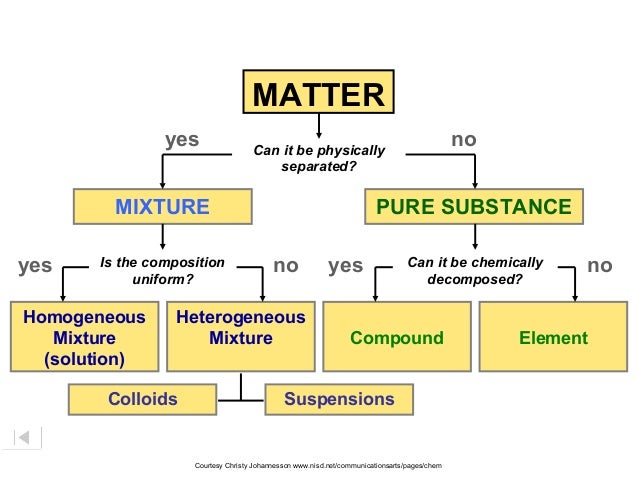
CLASSIFICATION OF MATTER


I. CLASSIFICATION SUBSTANCE(MATERIAL)
            The material is anything that has mass and volume.Therefore the material has a volume, it must occupy acertain space.All the thing that we can see or we touch,such as solar,wind,books,glass,water,and even our own bodies,all of them are composed of material.The chemistry in the investigation of studying the properties and changes of matter.
                 To study the properties of the material well,then in the chemistry of the material is classified/are classified as follow:

MATTER
Can it be physically
separated?
Homogeneous
Mixture
(solution)
Heterogeneous
Mixture Compound Element
MIXTURE PURE ...
A. PURE SUBSTANCE
    1. ELEMENT
              The element ia a single chemical substance can not broken down into other substance simpler.Examples of hydrogen and oxygen for types of gas can not be describe by electricity form the two types of hydrogen and oxygen gas.
                          Elements are grouped into three section,namely:
  • Metallic Elements, that is in general,the metal element has properties glossy white,has a low melting point,can conduct electricity,malleable and can conduct heat or hot.In general the metal is solid, but there is one element that is a liquid metal mercury.Here's sample image metal element.
               Hasil gambar untuk gambar unsur logam
  • Non Metallic Element,that is in general non-metallic element have properties not shiny,a poor conductor of electrical current, and can not be forged.In general,non metals are poor conductors of heat,but there is one non-metallic element that can conduct heat well,namely graphite.here's sample image non metallic element.

            Hasil gambar untuk gambar karbon


                Carbon         


          Sulfur
                           
  • Semi-Metal Element(Metaloid),that is element has properties between metals and non-metals.here's sampel image semi-metal element.
       Hasil gambar untuk gambar unsur silikonHasil gambar untuk gambar unsur germanium
                                                        Silicon                                          Germanium

    2. COMPOUND
         The compound is a combination of several elements that are formed through a chemical reaction.Compounds have properties that are different constituent elements.For example,two atoms of hydrogen with one atom oxygen can combine to form molecules of water(H2O).Hydrogen is a very light gas flammable, whereas oxygen is gas contained in the air which is indispensable body for combustion.
                                                    Hasil gambar untuk gambar senyawa co2
                                                                  Picture knot H2O

B. MIXTURE
        The mixture is a combination of several in the ratio does not remain without a chemical reaction.The mixture was divided into two parts,namely:
    1. HOMOGENEOUS MIX
          This mixture of two or more substances that the particles making indistinguishable called homogeneous mixture.Homogeneous mixture is often referred to with the solution.Example of homogeneous mix,among a others: a mixture of water with sugar called sugar solution, a mixture of water with salt called a salt solution.        
                                           Hasil gambar untuk gambar campuran homogen
                                                       Image Homogeneous Mixture
  
  2. HETEROGENEOUS MIX
         This mixture of two or more kinds of substances constituent particles can still be distinguished from each other is called a heterogeneous mixture.Example of heterogeneous mix: land,river water,food,sea water,etc.
Hasil gambar untuk gambar tanah
           Soil                
Hasil gambar untuk gambar pasir
                                                                                    Sand

   In the heterogeneous mixture divided into two pars,namely:
  • Colloid
               Colloids are mid conditions,including mixture and solution.In the case of colloidal dispersion(spreading) small particle but not the size of the molecule.the thing that distinguishes colloids form solution and the mixture is at its size.

                                 Hasil gambar untuk image colloid
  • Suspension
                 The suspension is a heterogeneous mixture of substances.Particle in suspension larger than the particle found in the solution.The particles in suspension will be visible to the naked eye,and they can be separated by filtration.Example of suspension:

                                            Hasil gambar untuk contoh suspensi dalam kehidupan sehari-hari
                                                 Drawing a mixture of water and oil


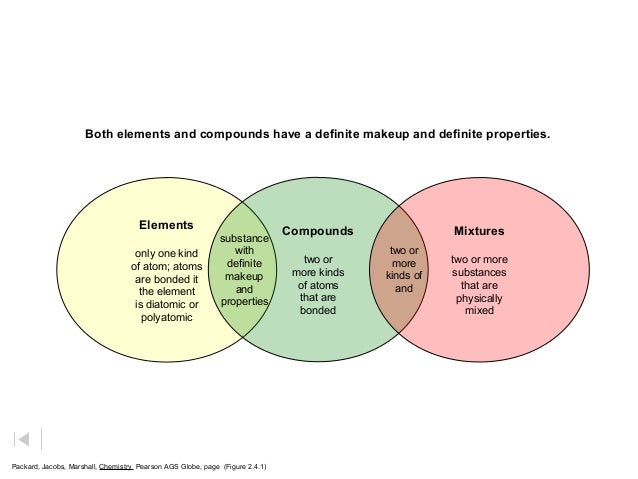
C. DIFFERENCES AND SIMILARITIES ELEMENTS,COMPOUNDS,AND MIXTURE

Hasil gambar untuk image both elements and compounds have a definite makeup and definite properties


MULTIMEDIA PEMBELAJARAN PADA ERA REVOLUSI INDUSTRI 4.0

A. Era Revolusi industri 4.0              Perubahan dunia kini tengah memasuki era revolusi industri 4.0 atau revolusi industri d...