ARTICLE 1
CLASSIFICATION OF MATTER
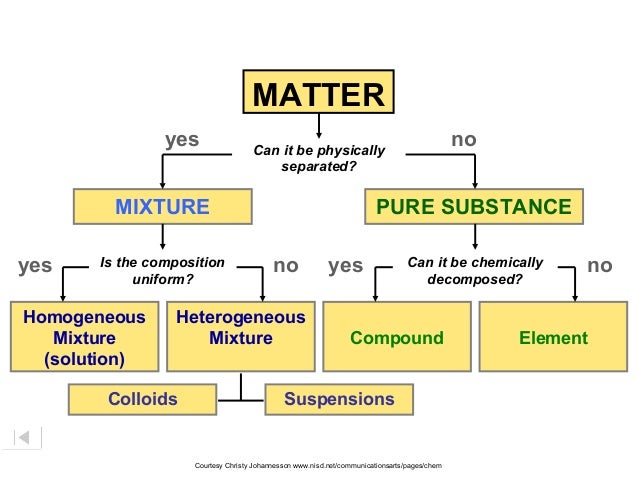
I. CLASSIFICATION SUBSTANCE(MATERIAL)
The material is anything that has mass and volume.Therefore the material has a volume, it must occupy acertain space.All the thing that we can see or we touch,such as solar,wind,books,glass,water,and even our own bodies,all of them are composed of material.The chemistry in the investigation of studying the properties and changes of matter.
To study the properties of the material well,then in the chemistry of the material is classified/are classified as follow:
A. PURE SUBSTANCE
1. ELEMENT
The element ia a single chemical substance can not broken down into other substance simpler.Examples of hydrogen and oxygen for types of gas can not be describe by electricity form the two types of hydrogen and oxygen gas.
Elements are grouped into three section,namely:
- Metallic Elements, that is in general,the metal element has properties glossy white,has a low melting point,can conduct electricity,malleable and can conduct heat or hot.In general the metal is solid, but there is one element that is a liquid metal mercury.Here's sample image metal element.

- Non Metallic Element,that is in general non-metallic element have properties not shiny,a poor conductor of electrical current, and can not be forged.In general,non metals are poor conductors of heat,but there is one non-metallic element that can conduct heat well,namely graphite.here's sample image non metallic element.


Carbon
Sulfur
- Semi-Metal Element(Metaloid),that is element has properties between metals and non-metals.here's sampel image semi-metal element.


Silicon Germanium


2. COMPOUND
The compound is a combination of several elements that are formed through a chemical reaction.Compounds have properties that are different constituent elements.For example,two atoms of hydrogen with one atom oxygen can combine to form molecules of water(H2O).Hydrogen is a very light gas flammable, whereas oxygen is gas contained in the air which is indispensable body for combustion.

Picture knot H2O
B. MIXTURE
The mixture is a combination of several in the ratio does not remain without a chemical reaction.The mixture was divided into two parts,namely:
1. HOMOGENEOUS MIX
This mixture of two or more substances that the particles making indistinguishable called homogeneous mixture.Homogeneous mixture is often referred to with the solution.Example of homogeneous mix,among a others: a mixture of water with sugar called sugar solution, a mixture of water with salt called a salt solution.
Image Homogeneous Mixture
2. HETEROGENEOUS MIX
This mixture of two or more kinds of substances constituent particles can still be distinguished from each other is called a heterogeneous mixture.Example of heterogeneous mix: land,river water,food,sea water,etc.
Soil
Sand
In the heterogeneous mixture divided into two pars,namely:
- Colloid

- Suspension

Drawing a mixture of water and oil
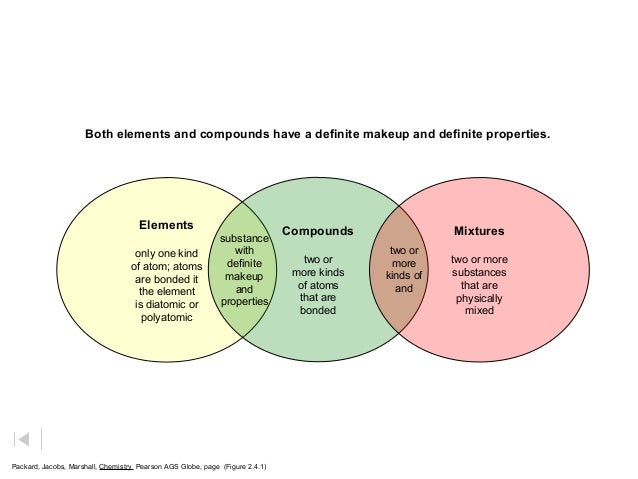
C. DIFFERENCES AND SIMILARITIES ELEMENTS,COMPOUNDS,AND MIXTURE


What substance making up ground so that the soil included in a heterogeneous mixture?
BalasHapusIn general, the soil is composed of four main components. Fourth components of the soil is mineral matter, organic matter, water, and udara.seperti we know that the heterogeneous mixture made of different materials which remain physically separated. Heterogeneous mixture always have more than one ground connection fase.Dan an example of a heterogeneous mixture because the soil is an example of a heterogeneous mixture that combines various elements are not uniform, which consists of components, namely organic materials, minerals, air, and water.
HapusSo.
A combination of two or more atoms, either atom
BalasHapussimilar atoms and between atoms
Different is called
Molecule is a particle (species) neutral consisting of two or more atoms, atoms either similar or different atoms.
Hapuswhy blood is called heterogeneous mix??
BalasHapusBlood is a mixture of compounds as in the blood also contains compounds known as oxygen or O2 binding results by hemoglobin (Hb) into HbO2 medical terms related to blood begins with hemo- or hemato- word derived from the Greek word meaning blood haima.
HapusHow manner of writing the compounds?
BalasHapusThe compound is written in the form of a chemical formula. Its chemical formula is a substance composed of a collection of symbols of elements with a particular composition. The composition is a number that states the number of constituent atoms (index number). For example, a compound consisting of atoms of the element sodium (Na) and atoms of chlorine (Cl). If the index number of atoms of each element is 1 and 1, the chemical formula of compounds formed as follows:
HapusThe index number Na = 1, the index number Cl = 1, so the chemical formula of the compound was NaCl (sodium chloride).
BalasHapusWhy in a non-metallic element graphite can deliver heat while others can not?
Because nonmetal is a group of chemical elements that are electronegative, which is easier to attract the valence electrons than other atoms rather than releasing them.
HapusWhat is the difference between compound and mixture?
BalasHapusDifference between compound and mixture
HapusCOMPOUND
1) Formed by chemical reaction
2) Comparison of the components that make up the compound is always fixed
3) Compound components lose their original properties
4) Can not be separated into its components by physical means, but must be through chemical reactions.
MIXED
1) Formed without chemical reaction
2) Comparison of components that make up the mixture is not certain and careless
3) The mixed components still have their respective properties
4) Can be separated into its components by physical way
you try to explain about the compound.
BalasHapusChemical compounds are pure chemicals consisting of two or more elements which can be broken down into their constituent elements by the chemical reaction. For example, dihydrogen monoxide (water, H2O) is a compound consisting of two hydrogen atoms for each oxygen atom.
HapusGenerally, these comparisons must remain due to their physical properties, not comparisons made by humans. Therefore, materials such as brass, superconducting YBCO, semiconductor "aluminum gallium arsenide", or chocolate are considered as a mixture or aloy, not a compound.
The distinguishing feature of a compound is the presence of a chemical formula. The chemical formula gives the atomic ratio in the substance, and the number of atoms in its single molecule (hence the chemical formula of ethene is C2H4 and not CH2) The chemical formula does not mention whether the compound consists of molecules: for example, sodium chloride (salt, NaCl is an ionic compound .
Compounds can be manifested in several phases. Most compounds can be solids. Molecular compounds may also be liquids or gases. All compounds will break down into smaller compounds or individual atoms when heated to a certain temperature (called decomposition temperature).
Every chemical compound that has been described in the literature has a unique identification number, the CAS number.
Why material must occupy an uncertain space?
BalasHapus
HapusBecause matter can generally be encountered in four distinct phases, ie solid, liquid, gas, and plasma (substances). However, there are other phases of matter, such as the Bose-Einstein condensate. So it takes a different space.
What is the difference of colloidal particles and molecules .. ??
BalasHapus